County Board reverses their decision
September 5, 2026
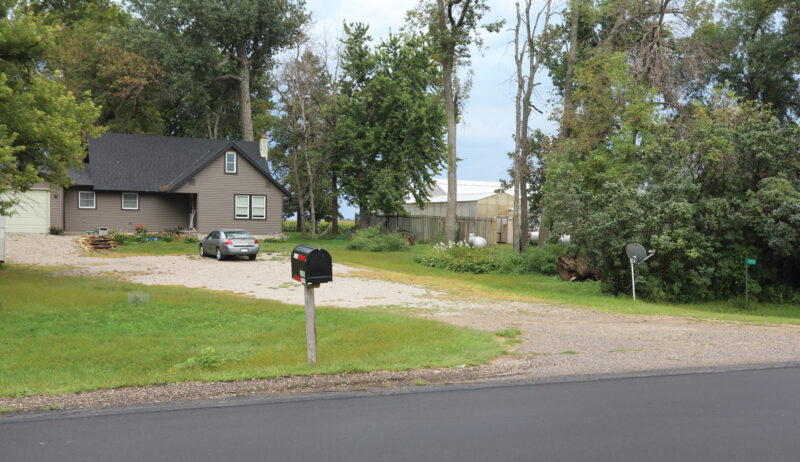
The house and property shown above sits very close to the proposed Cannabis Microbusiness that received a Conditional Use Permit at the County Board meeting last Tuesday. One of the conditions of the CUP is that a 12-foot high wall be erected to separate the adjacent properties on their common border.
A Conditional Use Permit (CUP) for a Cannabis Microbusiness which would be operated by Herbal Care, LLC, was once again the major topic of discussion by the Faribault County commissioners when they held their regular meeting on Tuesday, Sept. 1.
At their prior meeting on Aug. 18, the County Board voted, by a 4-1 margin, to deny the CUP while acknowledging the applicants had the right to have their business, which would be about one mile south of Wells, but questioned if the location was ethically the best place because of the close proximity of a family with three young children to the business.
At their meeting on Tuesday, the board decided to reconsider the CUP request. After a discussion, which lasted over an hour and included thoughts from county attorney Cameron Davis, Planning and Zoning administrator Sara Hauskins, the owner of Herbal Care, Markel Bababekov, and his employee, Kevin Kleinops, the board voted to approve the CUP with two additional conditions. One of those conditions was that a 12-foot high impervious fence be constructed on the north end of Herbal Care’s property and that the fans on the north greenhouse would act as intake fans and would not be exhaust fans which would blow air towards their property.
With those stipulations added, the vote to grant the CUP passed on a unanimous 4-0 vote with commissioner Tom Loveall being absent from the meeting.
The discussion began with Hauskins saying a formal request had been made on Aug. 18 by Bababekov for the County Board to reconsider their previous vote on the CUP.
“The request was forwarded to county coordinator Brian Hov, county attorney Cameron Davis and the board,” Hauskins commented.
Davis said he wanted to make sure the board was aware of the legal and political landscape of the issue.
“It the board were to deny the CUP, the next step for the applicant would be to appeal to the Minnesota Court of Appeals,” Davis said. “What we do in the county is the end of the administrative process, then it goes to judicial appeal where the county’s decision would be reviewed by an appellate court.”
According to Davis, the appellate court is normally going to give fairly broad discretion to the county’s determination for denial.
“The court would be determining if the county’s decision was arbitrary and capricious,” Davis stated. “The court is going to base that almost entirely on a written finding of fact. So, if the board is going to deny the CUP, a written finding of fact will be necessary as part of the process.”
Davis told the board a denial of the CUP would need to be based on established policy and preferably be based on the board’s historic interpretation of the zoning ordinance.
“When it comes to businesses like cannabis, they are very heavily regulated at the state level,” Davis remarked. “I know there is community frustration at the way the legislature legalized cannabis. As a member of the law enforcement community, I understand that and I share that. But unless and until those statutes are changed, there is not a lot we can do at a county level to regulate cannabis.”
Chairman Bruce Anderson offered his thoughts on the matter.
“One of the reasons we were worried was because of the health and welfare of the children and the family next door,” Anderson commented. “According to state statute, the conditions must protect the public interests. So the state statute and local zoning codes grant commissioners the power to grant restrictions deemed necessary to protect public health, safety and general welfare.”
Anderson then asked Davis if the commissioners can attach conditions besides what was on the original CUP application.
Davis responded, “Absolutely, yes.”
Commissioner Bill Groskreutz was next to speak and prefaced his comments by saying at the previous meeting he stated he believed that Herbal Care had the legal right to operate but that he was opposed to it.
“That was based on my feeling in regards to the legislation that was brought forward by the legislators a few years ago when they realized they had enough people in their camp and they were going to pass this legislation,” Groskreutz commented. “They pushed ahead and did even though the AMC (Association of Minnesota Counties), a number of counties as well as public health departments were opposed to the legislation. That was my reasoning for my vote.”
Groskreutz then pointed out that the only reasons you can deny a cannabis business are if the business is 1,000 feet from a school, 500 feet from a day care or 500 feet from a residential treatment facility or an attraction with a public park.
“All of those are places where there are children,” Groskreutz stated. “Just like this residence is a place with children. That was my reasoning for my voting no at the last meeting.”
Bababekov, who was participating in the meeting by Zoom, then read a lengthy statement outlining that his business had met all of the legal requirements to be granted the CUP while also agreeing to accept the two extra conditions regarding a fence and the fans.
Kleinops, who was also on Zoom, referenced an article by a Registered Nurse and mother who is also a cannabis cultivator. She explained in the article that the cannabis plants do not contain enough THC to be a risk to children.
“We want to be proactive so we have already rebid our north property fence,” Kleinops said. “The original estimate to fence our property based on state regulations was $69,317. To do a 12-foot high fence would increase that amount by $41,000.”
Bababekov also pledged not to grow a particular variety commonly referred to as the skunk variety.
“I am grateful that we are back here and trying to work out a solution to satisfy both the business owners and the residents of the home,” Anderson commented.
“I appreciate that you are back,” commissioner Gertrude Paschke added. “I am glad we are revisiting this.”
“Obviously we are trying to come to a resolution here,” commissioner Greg Young said. “You can see what our original thought process was and we understand your thoughts and reasoning.”
Young then moved for approval of the CUP with the added conditions. Paschke seconded the motion and it was passed unanimously.
Search
RECENT PRESS RELEASES
Related Post