From Precision Manufacturing to AI Factories: Foxconn’s Next Arena for Vertical Integration
October 31, 2026
From Precision Manufacturing to AI Factories: Foxconn’s Next Arena for Vertical Integration
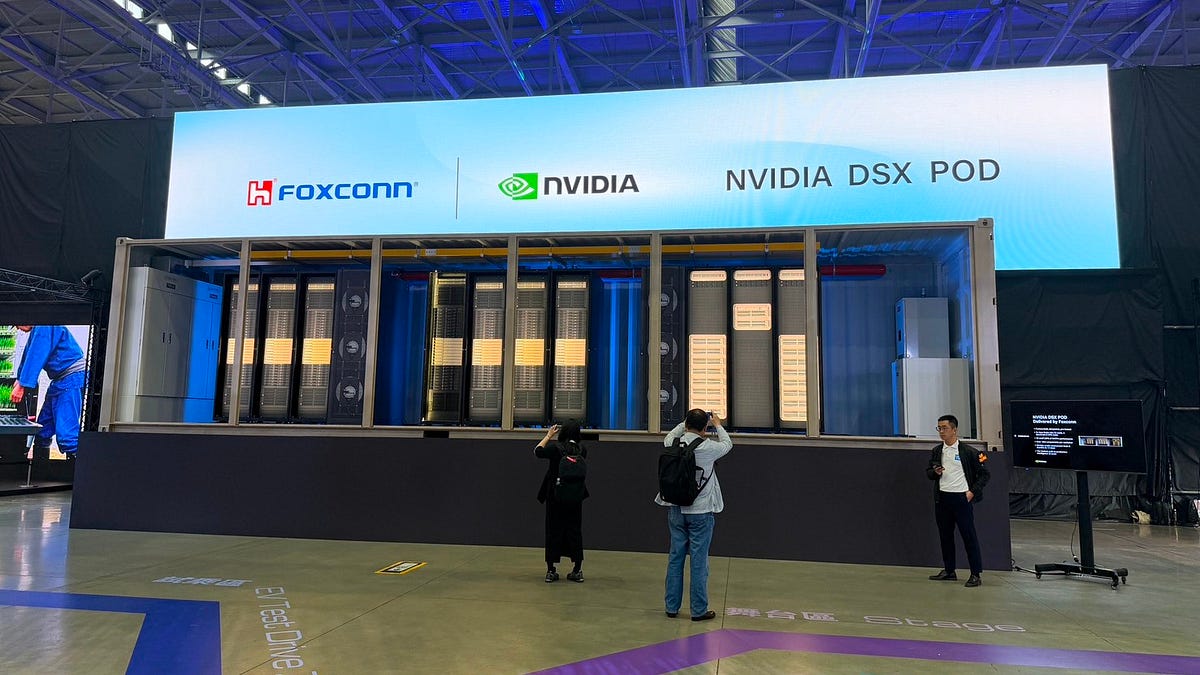
At the opening ceremony and main forum of Foxconn Technology Day on October 30, 2026, Foxconn’s message went beyond manufacturing scale. The company showcased how it is bringing precision machining, product design, system integration, and mass production together in a unified engineering model. From AI server racks, CPO switches, and modular data centers to a new lineup of electric vehicles, Foxconn’s central proposition is that vertical integration can shorten development and production cycles—and turn technologies once confined to labs or individual products into repeatable, scalable manufacturing processes.
The event highlighted three clear signals: AI rack output has doubled year over year, CPO is moving toward commercial production, and Foxconn is expanding its EV platform lineup with the Model A+, Model K, and Model K+.
Vertical integration starts on day one of product development
Foxconn said it introduced 941 new products for global Tier 1 customers in 2025, an average of about 2.5 products per day. More than half were developed under ODM or JDM models, reflecting a role that extends beyond contract assembly to include design, validation, and mass production tailored to customer requirements.
The group has approximately one million employees, including about 122,000 engineers. Foxconn reported that it obtained 2,492 patents over the past year, covering materials, equipment, and processes, and that it has been named to Clarivate’s Top 100 Global Innovators list for nine consecutive years. Foxconn also said it has maintained an ICT EMS market share above 40% for many years. Its globally managed land area exceeds 40 million square meters—equivalent to approximately 6,500 soccer fields. These figures demonstrate the group’s scale, but the forum’s larger point was how that scale can be converted into engineering capabilities that span products and processes.
Foxconn classifies its precision manufacturing capabilities into five levels. Wire products and protective covers require precision at around the centimeter level; server and EV structural components at around 50 microns; mobile phone components and precision molds at around 5 microns; optical lenses and optical communications components at 1 micron or finer; and, at the most advanced end, wafer manufacturing at the nanometer scale. Foxconn integrates four major manufacturing capabilities—subtractive manufacturing, forming, additive manufacturing, and joining—to address these different precision requirements.
In metal processing, Foxconn uses high-precision molds to form sheet metal through direct compression. For example, holes in laptop keyboards can be formed in a single operation. Foxconn said this process improves material utilization by 3.3 times compared with traditional machining, while precision molds can achieve an accuracy of 2 microns. The company also uses high-speed spindles operating at up to 40,000 rpm, together with precision cutting tools, to achieve machining accuracy of less than 1 micron. These capabilities are used for optical communications chip connectors and micro-optical components.
Foxconn’s definition of vertical integration goes beyond placing different types of factories within the same group. It brings component, mold, functional module, and system experts together as one team from the earliest stages of product development. The goal is to move optimization beyond individual components and improve the performance of the complete system. Engineering teams in Taiwan and the United States work in shifts across time zones to keep development moving around the clock. Foxconn said that some projects that would otherwise take three months can be completed in three weeks through this approach.
This integration also carries into production. Problems identified during assembly are fed back to design, mold, and machining teams for joint analysis and correction. Foxconn cited a precision substrate that guides optical fibers along defined tracks. The spacing error between tracks is kept within 0.3 microns, with a total error of just 0.7 microns. The company said it maintains the same level of precision and consistency across every production batch.
Process changes can also reduce cost and energy use. Foxconn said that replacing CNC machining of metal enclosures with precision molding and stamping could save approximately 8.33 million kWh of electricity per year at an annual shipment volume of one million units. That is roughly equivalent to the annual electricity use of 1,800 Taiwanese households, while reducing carbon emissions by nearly 1,900 tons. Foxconn identifies speed, quality, engineering services, flexibility, and cost as its five core competitive strengths. Its organizational culture, described as “division of labor” and “sharing,” is intended to let each unit develop its expertise and then share its technology, experience, and problem-solving methods across the group.
AI rack expansion and CPO’s move toward production
Search
RECENT PRESS RELEASES
Related Post