Most Promising EV Stocks for 2026 – The SWI Picks
June 29, 2026
Most Promising EV Stocks for 2026 – The SWI Picks
Still High-Risk and more volatile than the broader Market
Published by: StockWatchIndex Editorial Team
Rainer Poertner, Chief Analyst
The 2026 SWI Portfolio Setup
The EV industry matters because it is not just about cars. It is about manufacturing jobs, energy independence, national security, technology leadership, cleaner air, and control of the battery supply chain. If you’re looking for the highest upside EV-related stocks for 2026–2027, I’d separate them into three groups: established leaders, undervalued turnaround/growth plays, and EV ecosystem picks. That mix gives exposure to both the potential “next Tesla” winners and the more established EV leaders. It remains high-risk and likely more volatile than the broader market.
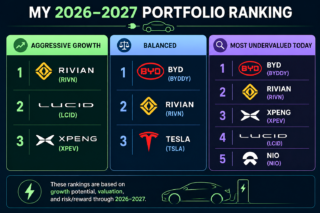
Risk-adjusted Ranking of Stocks
1. Rivian (NASDAQ: RIVN) — My top speculative EV pick ⭐⭐⭐⭐⭐
Why: The R2 launch is the key catalyst for 2026–2027 – Volkswagen partnership validates Rivian – Analysts increasingly view R2 as the make-or-break product to move Rivian from niche manufacturer to mass-market EV player – Trading far below Tesla’s valuation multiples.
Bull case: R2 becomes a Model Y competitor – Production scales successfully.
Risk: Still burning cash and not yet consistently profitable.
Potential upside: 2–5x by 2027 if execution succeeds.
2. BYD (OTC: BYDDY) ⭐⭐⭐⭐⭐
Why: World’s largest EV seller by volume – Expanding aggressively in Europe and emerging markets – Valuation remains dramatically lower than Tesla despite similar or higher vehicle sales.
Bull case: Continued international expansion – Margin improvements – Greater institutional ownership outside China.
Risk: China exposure – Geopolitical tensions.
Potential upside: 100–200% over several years.
3. Tesla (NASDAQ: TSLA) ⭐⭐⭐⭐
Why: Not really an EV stock anymore – Future valuation increasingly depends on Robotaxis, FSD/autonomy, Optimus robots, AI infrastructure. Energy storage business
Bull case: AI/robotics succeeds – Robotaxi network scales.
Risk: EV sales growth has slowed – Valuation already prices in substantial future success.
Potential upside: Lower than Rivian or BYD, but arguably lower risk.
4. Lucid (NASDAQ: LCID) ⭐⭐⭐⭐
Why: Luxury EV technology is world-class – New mid-priced models expected around late 2026–2027 – Uber robotaxi partnership adds optionality.
Bull case: Affordable models finally scale – Saudi backing provides funding runway.
Risk: Significant losses continue – Execution risk is very high.
Potential upside: 3–10x if turnaround succeeds.
5. XPeng (NYSE: XPEV) ⭐⭐⭐
Why: Strong autonomous-driving technology – Volkswagen partnership – Valuation remains much lower than many Western EV peers.
Bull case: Chinese EV market leadership – Software monetization.
Risk: Chinese market competition is brutal.
6. NIO (NYSE: NIO) ⭐⭐⭐
Why: Battery swapping network – Strong brand in China. – Valuation has collapsed from peak levels.
Risk: Capital requirements remain high – Profitability timeline remains uncertain.
This is a classic “either a Multibagger or a value trap.”
China is winning the EV Race (for right now)
The country that leads EVs will likely lead in batteries, software-defined vehicles, charging infrastructure, critical minerals, grid storage, and next-generation manufacturing. That is why EVs are strategically important, similar to oil, semiconductors, and aerospace. Right now, China is winning the EV race. China has the largest EV market, the strongest battery supply chain, and the most cost-competitive automakers. In 2025, China accounted for about 60% of global EV battery deployment, while the U.S. was about 10%. BloombergNEF also expects global passenger EV sales to keep rising in 2026, with China still driving much of the growth.
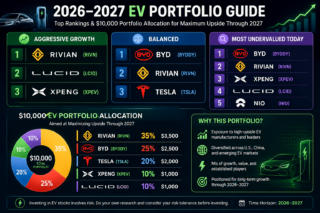
Deploying $10,000 Portfolio Allocation
The US needs to keep investing aggressively
China is likely to win the mass-market EV manufacturing race, especially in lower-cost vehicles and batteries. The U.S. can still win the higher-value race if it leads in autonomy, vehicle software, energy storage, charging networks, advanced batteries, and premium EV platforms. But the U.S. is not out. The U.S. still has major advantages in software, AI, premium brands, capital markets, energy innovation, Tesla, Rivian, GM, Ford, and domestic policy support. The Department of Energy has continued funding domestic critical-minerals processing and battery manufacturing, including a 2026 funding opportunity of up to $500 million.
So the most realistic answer is: China wins volume. The U.S. can win innovation, software, autonomy, and high-margin EV technology — but only if it keeps investing aggressively.

|
|
Search
RECENT PRESS RELEASES