New homegrown electronics help stabilize long-distance power transmission
September 6, 2026
Engineers in China are turning to a new generation of homegrown electronics to tackle the challenge of transporting power across thousands of kilometers to cities across the country as it expands renewable energy generation in its western regions.
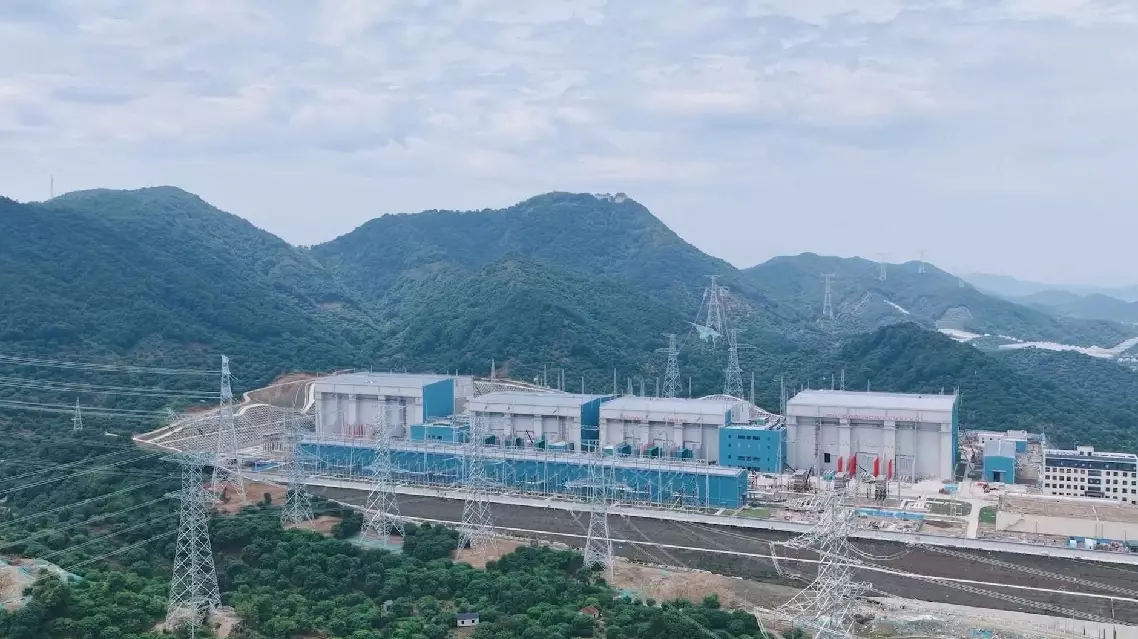
At a converter station in eastern China’s Zhejiang Province, the electricity coming into this station has traveled more than 2,000 kilometers from northwest China’s Gansu Province, across deserts and vast stretches of wilderness.
To transmit such a large amount of electricity over such a long distance without too much loss, it needs to raise the DC transmission voltage to ±800 kilovolts.
But compared with other projects of a similar scale, this one comes with an additional challenge — the electricity is coming from renewable sources.
The wind blows when it wants to, and the sun can disappear behind a cloud, so renewable power can fluctuate dramatically. And if wind and solar output in Gansu changes too quickly, those fluctuations can put serious stress on the power grid. Managing that variability has been one of the biggest challenges facing renewable energy for decades.
Now there is a way to deal with it. The key lies in one of the high-tech components. It is called the IGBT, a semiconductor device about the size of a fingernail.
It essentially works like a high-speed electrical switch. By switching on and off at high frequency, it can help stabilize the voltage within milliseconds, even when the grid is hit by a lightning strike or experiences sudden fluctuations.
But this “switch” is extremely demanding. In the past, limitations in materials and manufacturing meant it could only operate under relatively low current loads. But this project operates at ±800 kilovolts. The voltage and current that each tiny device has to handle can be enough to cause it to fail.
Now, Chinese-made IGBTs have reached the performance standards required for an application of this kind. And deploying this technology on a project of this scale is a world first.
“With domestically produced components, converter valves and transformers, costs will fall further, enabling wider applications,” said Zhang Mingjia, an engineering technology management specialist at State Grid Zhejiang Construction Company.
New homegrown electronics help stabilize long-distance power transmission
France has brought all its official gold reserves back home, in a move that netted more than 12 billion euros in profits — and underscored growing unease about the world’s heavy dependence on the U.S. dollar amid rising geopolitical tensions, according to a French economist.
Between July 2025 and January 2026, the Bank of France completed the transfer of the final 129 tons of gold, clearing out all holdings previously stored in the United States.
Older, non-standard bars held in New York were sold, and an equivalent amount of new, internationally standardized bars was purchased on the European market and stored in the central bank’s underground vault.
The operation required no large-scale physical shipment of gold and generated approximately 12.8 billion euros in gains.
The move comes as central banks around the world continue to increase their gold holdings, with some countries choosing to bring reserves home for greater security.
“What are the reasons behind this recent goal policy of France? As I said, the official reason was just to adjust the quality standard. But then we can see two other reasons. The other reason is a kind of geopolitical reasons, for sovereignty reasons. Central banks now are reconsidering the importance of gold because today the dominant currency in the world is still the U.S. dollar. But a lot of countries now think that there might be confidence problem in the U.S. dollar because of current U.S. policies,” Eric Monnet, a professor at the Paris School of Economics.

France pulls all gold from US amid mounting geopolitical concerns: expert
Search
RECENT PRESS RELEASES