The decline of Volkswagen: The highest‑grossing automaker, but its main rival Toyota earns
September 8, 2026
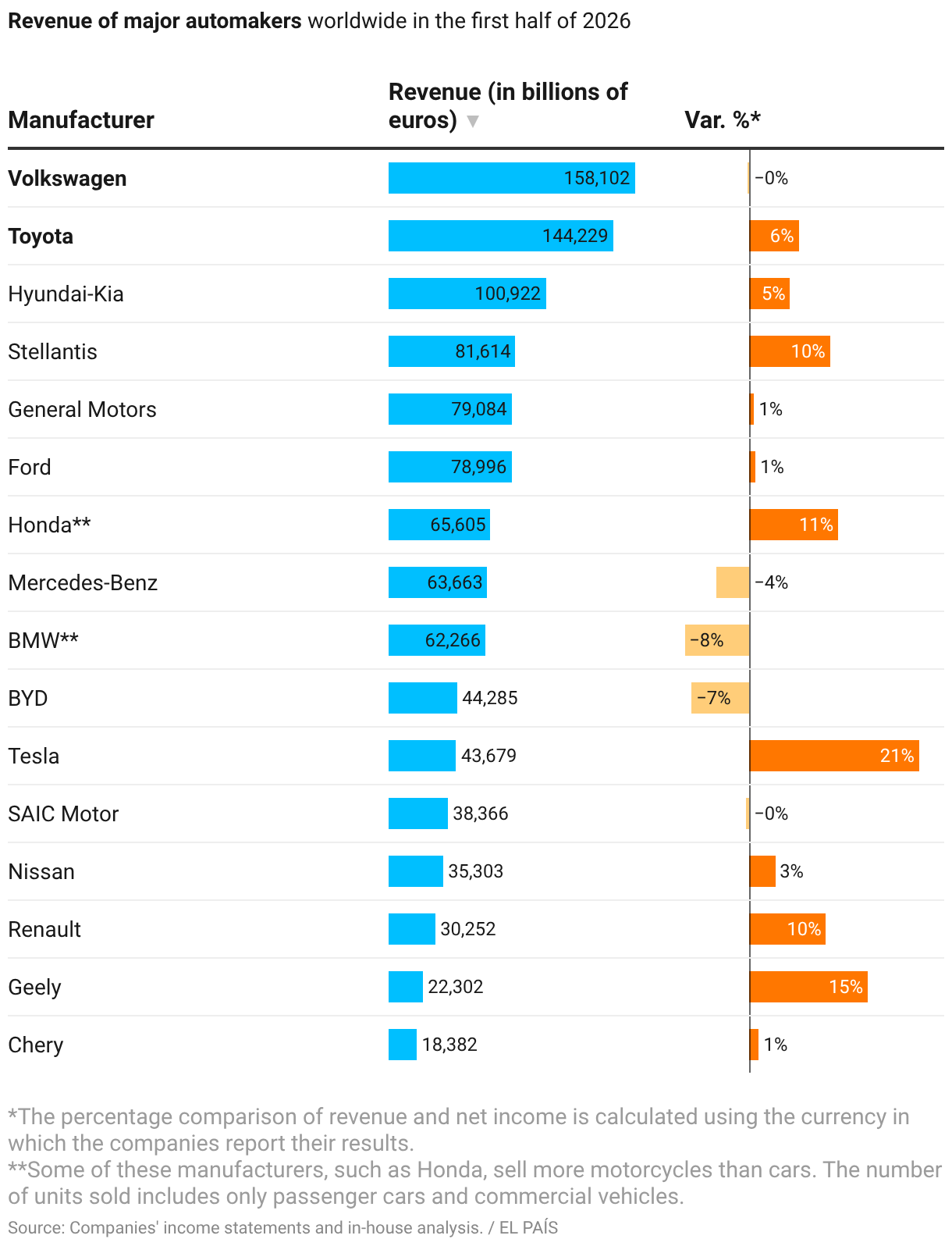
The agreement reached last week by Volkswagen’s supervisory board — which includes both labor unions and shareholders — comes at a critical moment for the company: despite high sales, its profits continue to fall. In the first half of the year, the German automaker was once again the world’s highest-grossing carmaker, with sales of €158.102 billion ($183.614 billion), virtually unchanged (only 0.2% lower) from the figure for the same period last year.
However, in a comparison of the results of the world’s major automakers compiled by this newspaper, Volkswagen lags far behind in terms of profits, a position held by Toyota. Between January and June — a period corresponding to the last quarter of the previous Japanese fiscal year and the first quarter of the current one — the Japanese company’s profits rose by 52.3%, exceeding 2.294 trillion yen, or just over $14.6 billion at the current exchange rate. During that period, Volkswagen posted a profit of $2.99 billion. The Japanese automaker also outpaces the German company in vehicles delivered — a trend it has maintained uninterrupted since 2020 — with nearly 4.7 million units compared to the 3.97 million sold by Volkswagen.
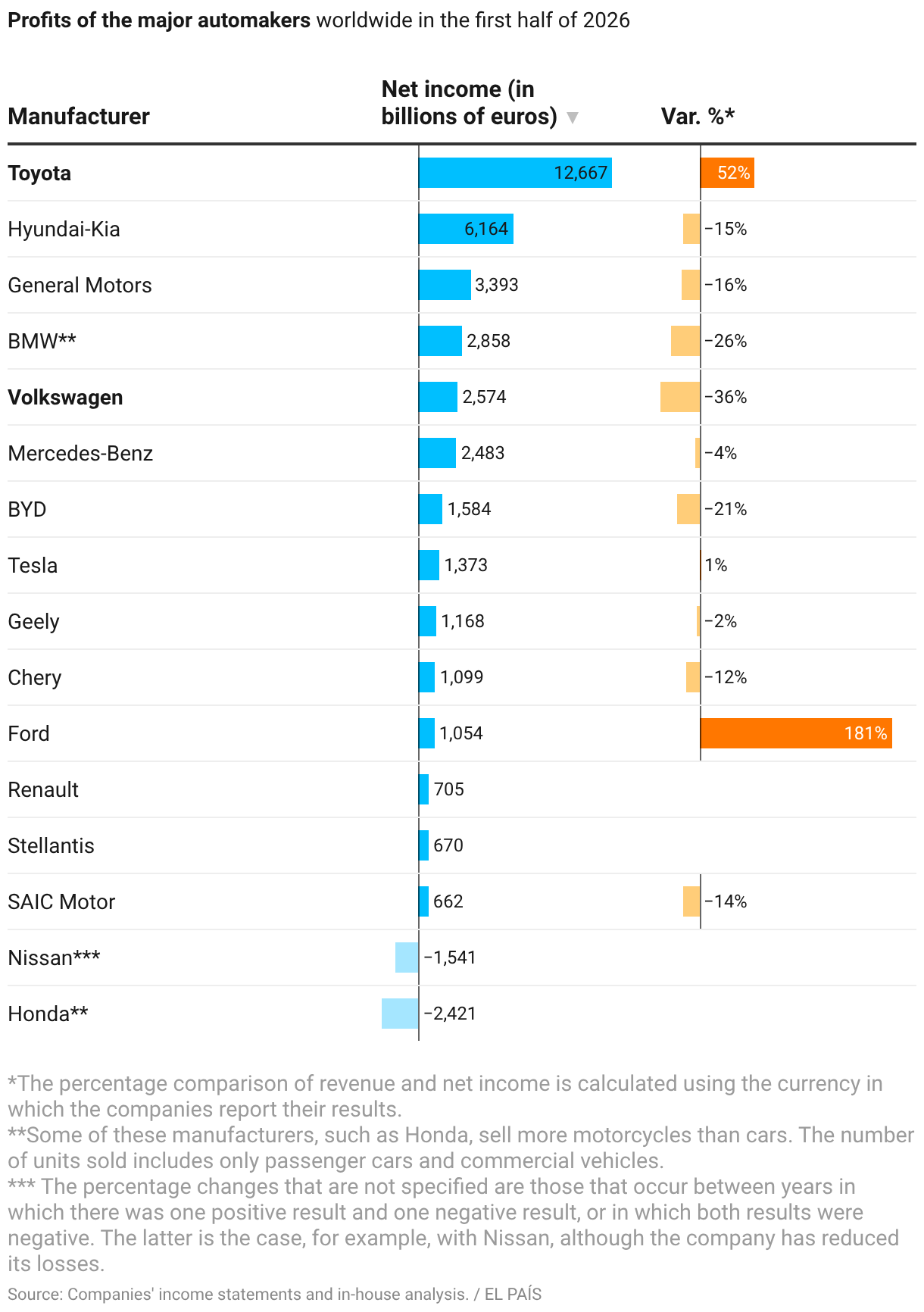
The German giant doesn’t even make it onto the global automotive profits podium, trailing behind the Hyundai-Kia duo, the U.S.-based General Motors, and fellow German automaker BMW, even though all of them saw their profits decline in the first half of the year due to the challenging times facing the automotive industry, driven by intense competition from Chinese brands — which have expanded beyond their domestic market to compete abroad— and the costly transition to electric vehicles. Toyota maintains its leadership in hybrid vehicles, which has allowed it to conquer markets such as Spain, where its main brand has been the best-selling one without interruption since 2022, something that had never happened before in a country where companies like Seat, Renault, and Volkswagen itself used to dominate.
The agreement reached by the supervisory board of the German consortium aims precisely to break this trend and boost profit per car sold to 9%, up from the 3.8% recorded in the first half of 2026. “Our operating margin remains too low and underscores the need for action,” Volkswagen CFO Arno Antlitz warned back in July, when it was already known that the group was planning a drastic workforce reduction of 100,000 employees, in addition to the cuts it had already announced starting in 2024. Ultimately, the cut was limited to an additional 50,000 workers. For now, the market has reacted positively to the adjustment, with the stock price rising 6.6% last Friday. Even so, it has fallen nearly 24% on the German stock exchange since the beginning of the year.
The first half also saw profit declines among major Chinese manufacturers due to intense competition, especially in the electric vehicle market, which, according to manufacturers themselves, does not deliver the same profit margins as combustion vehicles. BYD, the world’s largest maker of plug-in cars, cut earnings by 20.5% between January and June, down to the equivalent of nearly $1.86 billion. Even so, BYD managed to halt the losses it had been recording between April and June, posting its first year-on-year profit increase in five quarters.
Geely — the company that in summer signed an agreement with Ford to buy part of the U.S. automaker’s plant in Almussafes (Valencia) to produce its models there — is the second most profitable Chinese automaker, with about $1.36 billion. That figure is slightly higher than Chery’s (the owner of brands such as Omoda and Jaecoo), another Chinese manufacturer present in Spain, in its case at the former Nissan Barcelona plant, where it has settled with its local partner EV Motors to produce the Ebro brand. SAIC Motor, owner of the MG brand — the Chinese firm with the greatest penetration in Spain — reduced earnings by 14.4% to $768.8 million, although its revenue far exceeded Geely’s and Chery’s.
In the U.S., Tesla recovered on the sales front — up 16.3% versus the first half of 2025 — after suffering a sharp setback in deliveries due to competition from Chinese brands and a reluctance among some customers to buy cars from Elon Musk’s company, following his active role in the Trump administration in the U.S. and his support for the far-right AfD party in the 2025 German elections. Profit, meanwhile, remained virtually in line with the previous year.
General Motors cut profits by 16% to almost $4 billion, which nonetheless made it the U.S. automaker with the highest earnings worldwide through June. It ranked ahead of Tesla, Ford, and Stellantis — the latter a transatlantic giant formed by the 2021 merger of Fiat Chrysler and French group PSA. That group, which posted record losses of $25.94 billion last year, appears to have steadied the ship with profits of $778.1 million in the first half. Stellantis recently unveiled its new strategic plan through 2030, in which, like Volkswagen, it contemplates a capacity reduction in Europe of 17%.
Sign up for our weekly newsletter to get more English-language news coverage from EL PAÍS USA Edition
Search
RECENT PRESS RELEASES
Related Post